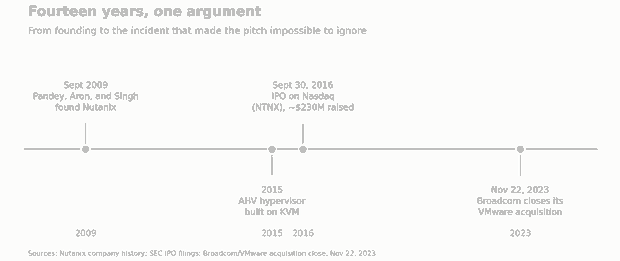
Every Nutanix product still answers one 2009 question: why does storage need its own box? If you have ever sat through a vendor pitch and wondered why anyone still buys a separate storage array in a year like this one, you already understand the argument three engineers made to the industry a decade and a half ago. Dheeraj Pandey, Mohit Aron, and Ajeet Singh had each spent years building distributed systems at a scale most companies never touch, Pandey at Oracle and Aster Data, Aron on the replication layer of Google’s file system, and in September 2009 they decided the answer to their own question was a company.
Three boxes, one job
Picture the data center Nutanix walked into. Compute lived on one set of servers. Storage lived on a separate array, connected over Fibre Channel or iSCSI, managed by a specialist who spoke a different vocabulary than the virtualization team down the hall. Networking sat in between, stitching the two together. Scaling any one layer meant a forklift upgrade to the others, and the storage array itself was usually the most expensive, least flexible box in the room. Three teams, three vendors, three support contracts, one workload.
Nutanix’s answer was to stop treating storage as a box at all. Instead of a dedicated array with its own controller, the company built software, first called the Nutanix Distributed File System, later renamed the Acropolis Operating System, that runs on the same standard x86 nodes as the compute, replicating and distributing data across the cluster instead of a single storage head. Add a node, and you add compute and storage and the software rebalances the data across it automatically. Manage the whole cluster from one console, called Prism, instead of three separate consoles that do not talk to each other. That is hyperconverged infrastructure, and Nutanix did not just describe the category, it built the company the category is now named after.
In 2015 the company went a step further and built its own hypervisor, AHV, based on Linux KVM. At the time that read as a way to undercut VMware’s licensing costs inside a Nutanix cluster. In hindsight it reads as one of the more prescient decisions in enterprise infrastructure, for reasons the industry would not fully appreciate for another eight years.
The proof that came first
On September 30, 2016, Nutanix listed on Nasdaq under the ticker NTNX, raising roughly $230 million at $16 a share. An IPO does not prove a technology is right, but it proves a business model survived contact with public markets, and Nutanix’s did.
The incident that is still proving the pitch
Then, on November 22, 2023, Broadcom closed its acquisition of VMware, and the industry got a live demonstration of exactly the risk Nutanix had been arguing against for fourteen years: what happens when your entire infrastructure depends on one company’s licensing terms.
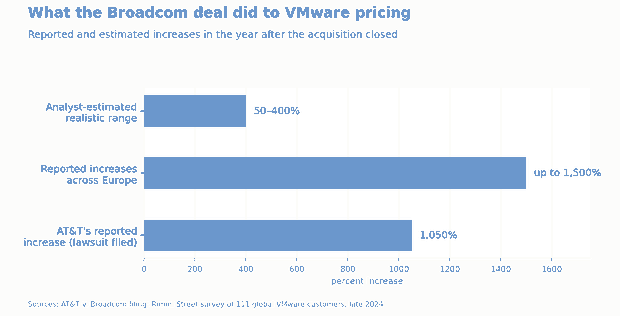
Broadcom moved VMware from perpetual licenses to subscription only, bundled products that used to be sold separately, and raised prices hard enough that AT&T reported a 1,050 percent increase and sued. Customers in Europe reported increases up to 1,500 percent. Analysts studying the broader customer base put the realistic range at 50 to 400 percent, still enough to break a budget built on the old numbers. A Rimini Street survey of 111 global VMware customers in late 2024 found 98 percent already using, planning to use, or actively considering an alternative, and 36 percent had already switched.
Nutanix added more than 2,700 new customers in fiscal 2025, including more than 50 Global 2000 accounts, on its way to a customer base over 29,000. Full year revenue reached $2.54 billion, up 18 percent year over year. Annual recurring revenue closed the year at $2.22 billion, up 17 percent. Seventeen percent ARR growth against 18 percent revenue growth is a company still compounding, not a company coasting on someone else’s bad year.
So is Nutanix simply the better choice, full stop? No. That is where the pitch has to stop and the honesty has to start.
Where the pitch runs out
Migrating off VMware is real, multi-month work, not a weekend project, and every workload that depends on VMware-specific tooling has to be re-validated on the new platform before anyone should trust it in production. Hyperconverged infrastructure also is not the right shape for every workload. A cluster built around distributing storage across compute nodes is not always the cheapest or most efficient answer for workloads that need enormous storage capacity with comparatively little compute attached, where disaggregated storage still has a real argument. And Nutanix, even at $2.54 billion in revenue, is a fraction of the size of Broadcom, which changes the risk conversation from vendor lock-in to vendor durability.
I’ll declare my own bias here rather than hide it: years of presales work across storage and virtualization have made Nutanix my default recommendation, technically and personally. Weigh everything above with that in mind.
None of that erases the argument. It just means the argument was never “Nutanix has no downsides.” It was always “the downsides of three separate boxes were worse, and now the downsides of the old alternative have a dollar figure attached.”
Takeaways
- Nutanix was founded in September 2009 by Dheeraj Pandey, Mohit Aron, and Ajeet Singh to collapse compute, storage, and virtualization onto standard x86 nodes instead of a dedicated storage array.
- The company built its own hypervisor, AHV, in 2015, reducing dependence on VMware years before that dependence became an industry-wide liability.
- Broadcom’s VMware acquisition closed November 22, 2023, and its licensing changes produced price increases up to 1,500 percent for some customers, with 98 percent of surveyed VMware customers considering alternatives by late 2024.
- Nutanix added over 2,700 customers in fiscal 2025 alone, closing the year at 29,000-plus customers, $2.54 billion in revenue, and $2.22 billion in annual recurring revenue.
- The honest caveats still stand: migration off VMware is real work, and HCI is not the best fit for every workload.
Published September 29, 2026